Wednesday, April 25, 2007

Yellow River

Here comes another dose of expressive stimulant… to ‘charge up’ – according to our ‘batteries’ theory.. haha!

The Yellow River concerto has always been one of my favourite piece, but it is hard to find performers that can actually bring out its underlying significance and majesty
A little background…
It was adapted from Xian Xinghai’s “Yellow River Cantata” in 1940… The Yellow River is seen as a persistent musical theme and also a metaphor for China – praising the glorious history of the Chinese nationality (zhonghua minzhu) and the persistent struggling spirit of the Chinese citizens; it bitterly criticizes the cruelties of the oppressors and the torment suffered by the Chinese people. Hoping to nourish a sense of belonging and concern, nationalists pulled on the nation’s musical heartstrings. According to Ellen Judd, in China’s cultural redefinition in the 1940s, the performing arts offered the peasantry a “persuasive presentation of a new conception of the world” (Judd 1986, 31). Think the period when this cantata was composed coincides with Mao Zedong’s 1942 Yan’sn Talks on Literature and Art stating the central principle that art should be based on, reflect, and serve “the people”.

I finally found a video of this Yellow River concerto performed in the 70s in China.. I thought the pianist did wonderfully in portraying the underlying musical significance…the historical, political and economical significance. He really has the fire when he plays.. must watch k.. hope you guys will be inspired too!!
The weird thing is this is suppose to be a western orchestra how come there is one pipa player inside

1st movt.: Yellow River Boatman’s Song
http://www.youtube.com/watch?v=uopB0QCgEqw

2nd movt.: Ode to the Yellow River
http://www.youtube.com/watch?v=IfdOyOb0Lr8&mode=related&search=

3rd movt.: Wrath of the Yellow River
http://www.youtube.com/watch?v=gau1pYEhfz8&mode=related&search=

4th movt.: Defend the Yellow River
http://www.youtube.com/watch?v=HK2PyFKh2Ao&mode=related&search=

Anyone knows who is that guy on the portrait at the background can let me know? he dosent look like Mao.. this portrait was captured in the performance of the 4th movt.

Thursday, April 12, 2007

Rach's 3rd

I watched the video of Olga Kern performing the 3rd piano concerto by Rachmaninov at the Eleventh International Van Cliburn piano competition and it was really brilliant! virtuosic fingerworks and the passionate artistry aside... what makes it even more admirable is that she played it with minimal pedalling.. which actually makes it even more challenging to produce the shades of colour, considering that there are very chordal passages and relying mostly on hand pedaling to build up the climax and emotions really require remarkable skills

I heard Rachmaninov and he himself played it without (or with very subtle) pedal, as can be discerned by that 'dryness' in his recording... but i wonder why? with pedal the effect could be better and achieved with much less effort... perhaps he desired for that clarity? or maybe the presence of orchestral accompaniment (esp the winds and brass inst.) to a certain extent helped mask that dryness so it is ok it dosent sound so connected between the massive chords?

Oh and Van Cliburn's rendition of the Liszt Hungarian Rhapsody no. 12 was awesome!! It must have been a sensation for those watching him live.. Am sooo excited after watching this that I dont think I will fall asleep anytime soon... haha.. Great performances are always a pleasure to one's senses... Anyone interested can go to http://www.youtube.com/watch?v=KAqA2E5D0lI

Saturday, March 31, 2007

'Phoenix' Concerto - Structural Influences

As we know, the use of ternary form (compound ternary in this case) is one of the most frequently used structures in music compositions, especially as a means to create contrast (i.e. in terms of tempo, character, or motivic ideas…).

However in this piece, it seemed to have achieved a combination of artistic effect from both the Western and Chinese tradition. Cos I read in some Chinese music text, they have this very conventional structural feature which they termed as “鱼咬尾”, which is found in this piece as well, as far as I can see. For illustrations, see bar 43, which signals the closing of section ‘a’ but the beginning of section ‘b’; bar 67 which is indicates the end of b section but also the beginning of a1. This continues at many junctions where one section leads in to another,thus in a sense contributing to the fluidity and link throughout the piece.


Interestingly we see from here how the composer draws upon features from chinese musical tradition and infuse it within the western formal structure.


short-range voice connections

Hmm.. I see some short-ranged voice leading connections... not sure if there are longer
connections


Monday, March 19, 2007

'Phoenix' Concerto - Motivic “Paradidle”


It’s amazing how the main theme of section B is only based on the ordering of 4 note motif - ‘B’, 2 ‘E’s of different registers and ‘A’. Hence in a sense, it's like ‘paradidle’ in percussion since it essentially uses the various permutation of the 4 notes to actually spun a melody. (Note: I termed it 'paradidle' is because of the piece’s percussive nature and how such motivic ordering may be associated to the paradidle, but of course it is not to be taken literally). Sometimes the introduction of B flat and E flat might possibility be to create surprise or to create some voice leading tendency, to propel the music forward…
See how B flat leads to A in the diagram below:

This melody is always set over a submediant pedal, quite uncommon eh since we often encounter tonic or dominant pedal.. but submediant!


Sunday, March 18, 2007

'Phoenix' Concerto - Harmony

This piece contained many dissonances brought about by note clusters, especially in accompaniments or between solo and accompanimental parts. Throughout the piece, the tonal centre is also blurred by the false-relations that exist between different voice parts. So I’m not sure if it makes sense to analyze the chordal progressions in this piece, because it felt like the composer is more concerned with the soundscape produced, rather than using any specific chord progression or the tonality. I think the presence of false relations were due to the linear as opposed to vertical thinking in the harmonic parameter. Throughout section A, the characteristic interval of a major 2nd and minor 7th are the two very predominant intervals used – contributing to the distinctive clashes. For instance in bar 1 – R.H. F# is set against F natural in the L.H. But it seems like there are a couple of underlying reasons for having that F#:


  • Contribute to the more pentatonic nature of the work – creating a perfect 4th (a very characteristic interval found in Chinese classical music) instead of a tritone with ‘B’

  • Due to the anhemitonic scale used, to avoid creating a semitone with note ‘E’ (linear thinking). Because it seems that throughout section A, the composer consciously avoids consecutive semitonal movement within the same voice.

  • F# increases the note tendency to go to a G, which finally came at bar 5.


As mentioned above, the composer seemed to avoid successive semitonal movement within the same voice in section A. When chromatic movement is used, there are also notes in between to separate it. (see below for the chromatic voice leading)


I notice that there is abundance of open 5ths and octaves (e.g. bs. 9, 43) apart from 4ths, which would have caused the piece to sound very bare, like The Sunken Cathedral by Debussy. Although both pieces are pentatonic in nature and filled with such open intervals, the atmosphere created is quite different – This concerto (esp. section A) do not sound as hollow as that felt in The Sunken Cathedral and it is interesting that we as listeners do not feel the awkwardness such bareness in this piece. Perhaps it is how the composer managed to ‘mask’ the bare sounding chords through the choice of registers..? Notice how the spacing between L.H. and R.H. were very close together (e.g. b. 117, 338 – R.H. octave is like an ‘echo’ of the L.H.).


Sometimes even though the instruments are playing octaves in unison, for instance at bar 274 – 284, with range that spanned 3 octaves, the texture created is dense, not thin and empty. The spacing of chords, fortissimo and the quick tempo might be some contributing factors.


Saturday, February 17, 2007

'Phoenix' Concerto - Of Rhythmic and Pulse Interest

I felt it was fascinating how the composer managed to infuse so much rhythmic interest into what looks to be very regular rhythms on the surface (e.g. semiquavers, quavers, crotchets, and sometimes long held notes). Perhaps it was the way he combines these rhythms with staggered entrances, coupled with the persistent use of accents on weak and off beats (syncopations) that upsets the regularity of the pulse, injecting in the music a sense of rhythmic interest. But because there are many little recurring fragments of melodic ideas subjected to syncopated treatment throughout, that gave it the feel of regularity within irregularity and vice versa. I feel that this unique mood portrayed can be relieving in some extent.

Of course, the use of syncopations in Chinese music is not uncommon, especially for accompaniment but it is actually quite rare to actually find such extensive use of syncopations for the melody. Instances can be heard at 0’20 – 0’30; 0’43 – 0’51 etc. (see diagrams for illustrations)


Another very prominent aspect is the frequent change in time signature.
Right from the beginning (0’00 – 0’15), the subtle change in time signature from 6/8 passing through 2/4 before going to 3/4 made the transition in meter smooth. (i.e. 6/8 and 2/4 both can be sub-classified into 2 groups, except that 6/8 consists of groups of 3 quavers while 2/4 consists of groups of 2 quavers. Leading in to 3/4 from here would not upset the metrical feel too much).


It was also interesting how he creates a little tension in the piano part before ushering in the yangqin (main character, if speaking from the operatic point of view) by inserting an extra crotchet beat to build up a little climax. Note the change from 4/4 to 5/4 in that little 2 bar link from 0’15 – 0’20. Once the yangqin enters, the meter went back to 4/4 again.


During the last time where this 2 bar link is featured, the composer surprises us with a 4/4 to 3/4 change instead of a 5/4 change which we have been conditioned to expect, from the many previous appearances. (heard from 13’07 – 13’10)


Sometimes, even though the time signature remains unchanged, the displacement of regular metrical pulse is actually created by the playing of registers, for instance at 0’51 – 0’59, 4’20 – 4’36.


The registral change also aids in creating the impression of rhythmic complexity as heard from 13’53 – 14’19, where the texture slowly climaxes towards the end of the piece.

I also found instances where the perceived meter is not what was stated in the score, due to the rate of harmonic change and phrase structure that conflicts with the actual time signature. One example would be the middle section, 6’02 – 6’54 or a more decorated version from 7’48 – 8’40.


The main accompanimental figuration was also ingeniously ‘tampered’ with so that its recurrence is not always exactly the same. Although it was only altered from 6/8 to 5/8, but I feel that such little variation actually added variety to the already interesting music. (Compare between 0’59 – 1’05 and 1’28 – 1’33)


There is an instance at 11’45 – 11’54 where the feeling of antecedent and consequent phrase (period) relation could be subtly felt. This is brought about by the addition of just one quaver note which allows the consequent phrase to have the last note rooted in the dominant or tonic, giving it a slight sense of closure. Or maybe it’s also due to the more even time signature of 10/8 in the consequent phrase as compared to 9/8 of the antecedent phrase.


'Phoenix' Concerto - Rhythmic Influences from Opera

Since the term “凤点头” refers to the drumming pattern of Chinese opera, this piece must be infused or embellished with such rhythms.
So, I’ve spent some time delving into this aspect which is not very familiar to me and managed to identify a few main patterns. It was an eye-opener for me as I have seldom come across such specific percussive rhythmic patterns being infused in a melodic instrument; much less provide a rhythmic structure for the music.

Ø Bars 9 - 12 (0’11 – 0’15) resembles the rhythm “ 3/4 [乙才] [乙台] 匡” ([yi cai] [yi tai] kuang) also termed as “马腿儿” (ma tui er) rhythm unique to opera music.
N.B. [ ] represents quaver because this blog dosent support e underline format


Ø Bars 77 – 84 (1’41 – 1’55) piano accompanimental rhythm uses the characteristic interval of minor 2nd (see R.H.) and major 7th (see L.H.) to create a timbre that is similar to that of the Chinese big drum. The rhythm [XX] [0X] [0X] [0X] is also distinctive to the drumming patterns of this Chinese drum.


Ø Another very distinctive operatic element could be heard from 4’36 – 5’05.
It is quite amazing how the composer uses this element as a link to connect section A to section B. This is often found in Chinese opera music, especially the part just before the main character is put into the limelight.


We can also extrapolate this essence into the concerto, since the upcoming section after this string of characteristic rhythmic figurations pose a sharp contrast to section A in terms of mood, texture and soundscape, it's like another ‘character’ being introduced on stage.
Thus in a sense, the competitive atmosphere brought from the previous A section between the yangqin and piano could be viewed as an ‘overture’ for the main theme of section B.

Friday, February 16, 2007

'Phoenix' Concerto - Structure, Melodic element

This piece is in ternary form and to be precise, I think it is a compound ternary.
Section A: Bars 1 – 213 (0’00 – 5’06)
Section B: Bars 214 – 343 (5’07 – 12’56)
Section A’: Bars 344 – 417 (12’57 – )

Under each of the 3 sections, it can further be classified into smaller segments according to the various melodic ideas as shown below:
(Timings are shown below the melodic fragments)


It is deeply contrasting between section A and section B especially in terms of its mood, tempo and also the thematic material. They sort of represent two extreme atmospheres, the percussive and bold section A with the mysterious sounding or sort of ‘nocturnal’ section B. Section B encompasses 2 emotions: from lyrical/ gentle to fiery and passionate.
Here, the theme is introduced by the piano for the first 8 bars, followed by a repetition of the exact same theme by the yangqin. It is actually quite difficult for yangqin to produce such expressive sounds since it’s often considered a percussive instrument, but it is remarkable how the composer uses the rare 9 single stroke roll technique to give listeners an illusion of ‘a line connected by dots’.

Within each section, the various little melodic fragments unique to that section are constantly brought back, sometimes with modifications and sometimes without. I suppose it is because the melodic fragments in this concerto are neither singable nor could easily be remembered, given its characteristic clashes and dissonant leaps all over especially in the first section. So there is a need to constantly reiterate these ‘points’. Or perhaps it is also something to do with Chinese opera influences? – where each melodic fragment represents a character in the plot..

But generally, I notice that the extent of exploration or development of the melodic fragments is quite little. Most of the time, it is repeated in its original form, which in a sense makes it easy to recognize… Perhaps that’s why the piece is full of rhythmic excitement, and many different melodic ideas to make up for the lack of thematic development.

Thursday, February 01, 2007

"...technique is something that can be mastered by anyone overtime, what distinguish the best musicians are their musicality and sensitivity, which can be taught by no one, except yourself.. by your heart..." - qls

Thursday, January 25, 2007

凤点头 (The ‘Phoenix’ Concerto)

Some background info…

This concerto was composed in 2003 by Prof. Xu Chang Jun (徐昌俊) from Central Conservatory of Music in China. It was written for the yangqin, accompanied by the string ensemble with 6 violin I, 4 violin II, 3 viola, 3 cello and 2 bass. But what I have is the reduced score accompanied by the piano.

It was after I had gone for yq lessons for this piece did I realize that it was actually infused with lots of elements found in Chinese opera music, especially in terms of its character. Chinese opera can generally be divided into "civil" pieces characterized by singing, and "martial" ones featuring acrobatics and stunts. This concerto belonged to the latter, hence explaining its percussive and virtuosic nature. 凤点头 was actually the name of a particular type of drumming pattern often found in opera music, therefore if we were to listen carefully, we could actually pick out these patterns that were embellished inside the music.
I’ll be examining in my following postings, certain aspects of this piece that differentiates it from the usual Chinese classical piece that we often hear.

At first listening, this piece does not sound exactly Chinese; this was probably due to some 20th Century Western compositional techniques/ elements that were incorporated together with Chinese elements, especially in terms of harmony and rhythms. This concerto has often been acclaimed as a mix of the East and West from what I have heard which I hope to examine why is it so and also the contributing factors that bind the piece together.

The element of contrast is also quite prominent in this piece, hence I would also be delving into this area.

I have uploaded a very low resolution video clip for this concerto (performed by me during a practice session before the finals.. haha), it may take quite some time to load. The sound quality is also not very good. If any of you prefers a clearer version pls let me know so I can lend the vcd to you :D
This clip can be accessed via http://sg.geocities.com/yickjr/

Friday, January 12, 2007

will i survive?

Ahh...... It's just jan. and i'm already fully booked till dec... Have at least 8 concerts and a major exam to prepare this year... i'm becoming like a part-time performer now... haha oh gosh!!

Monday, January 01, 2007

Hail to 2007!

Happy New Year to all!

This is going to be another busy year for us.. Ah!! school is reopening in 6 days time and we shall be subjected to more stress and hours of mugging soooon..
haha so lets savour our last wk of holiday and take a deep breath before we start our 'endless' race of meeting deadlines

Saturday, December 16, 2006

Big Day

Set off for SCH in the morning to attend rehearsal for tonight's PPC..

Met old and new yq frens and had a great time catching up on each other's life as well as exchanging ideas on yq matters.. haha fun, fun!


The prize winners' concert was ok, I particularly liked qing lun's dizi and also dedric's suona performance, marvellous expressions and techniques mann.. got a great deal to learn


Had a chat with liu lao shi after the whole thing, encouraged me and told me to pick a few pieces that i really like and feel it inside out.. so that it would become my 'signature piece'.. haha hmm sounds logical.. shall start some indepth analysis to certain pieces soon


us with qu lao shi and liu lao shi in the middle


Friday, December 15, 2006

Inspiration

Attended yangqin masterclass today at SCH by Prof Liu Han Li from Shenyang Conservatory of Music. Learnt a great deal about music analysis and how to go about performing it.. It was quite brain stimulating and really opens up my dimension about music performance. Oh ya and he gave each of us a book which contained his yq compositions plus some of his thoughts about yq performing, techniques of playing and it's history.. Flipped through and some of those are really chim man.. haha guess i would understand these big theories overtime

Gotta start practicing new pieces for Diploma exam next year.. still contemplating whether to take nafa or nus one.. Oh and Qu lao shi said she hopes to hold a concert next year (if she can find sponsors) featuring all her students.. Wow great! another performance platform gained

2006 National Chinese Music Competition

Just finished my finals in the yangqin open category yesterday... Came in 2nd!

Phew... Finally can enjoy my vacation!!! It has really been a busy semester for me

Sunday, December 10, 2006

YEAH

Woke up at 6am today to have breakfast and do some warm up prep runs for my preliminary round.. felt really excited and to a certain extent.. anxious
(yea, i'm the only female competitior)
Left home early following the advice of my teacher.. and guess wad.. i reached esplanade @ 8.00am. Not a soul in sight at the reporting place.. had another 30 mins b4 the actual reporting time, so i just get changed and waited for qu lao shi...
At backstage, i did more warm-ups and settled down to wait for my turn.. (i'm competitor no. 2)
During my performance, i felt i did quite ok (although not my best), except for a few missed notes during the fast section of my set piece.. but teacher was quite happy with my performance
Ahh was so nervous when the results were annouced, especially when jj said that only 2 competitors got into the finals.. wouldnt forget that moment when my no. was announced, i felt euphoric!
Outside, my payco supporters were wild.. fortunately i didn't disappoint them..
and thanks jean for coming down so early in the morning to support me

Friday, November 10, 2006

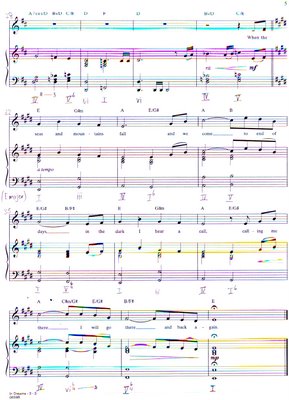
In Dreams - Harmonic, melodic analysis

Continuity and unity achieve through harmonic, melodic and phrase treatment

An interesting point I observed is that most cadences in this piece occur from the strong to weak beat instead of the usual weak to strong beat, such as seen in bar 10 (plagal cadence), bar 12 (imperfect cadence) etc. This actually reduced the effect of cadential punctuation, injecting in the music a sense of continuous flow.

I also observed how the composer juxtaposes contrasting feelings in the same phrase.
In the main theme (see bars 9-12), the melodic idea felt calm and lyrical. Judging by the balanced and symmetrical melodic contour, a sense of closure is somehow felt. But the subtle usage of imperfect cadence (bar 12) injects a sense of incompleteness to this closure, spurring the music on as the tension for resolution is heightened.

Sometimes the embedded harmonic progressions also underline a certain melodic idea. For example in bar 17, the harmonic progression vi(6)–V(6/4)–vi(6/4) of D major [where its base notes are also D – E – F sharp] actually underlines or echoes the motif D – E – F sharp from the theme with rhythmic augmentation.

Another interesting aspect in bar 18-19, as seen in the bass progression, D–E–F sharp–E, underlying vi6-V(6/4)-vi(6/4)-V progression, the note ‘E’ has the tendency to resolve onto ‘D’ (chord I), but the composer proceed to a ‘G’ (chord IV) instead. Probably by prolonging this resolution to tonic, the music is equipped with some harmonic tension to portray the mood - that of restlessness above tranquility in the piece. It is also rare for chord V to precede chord IV, well at least not in the usual Classical music that we hear.

Fluidity in texture also contributed in giving the music a sense of continuous flow. This fluidity is in some way achieved by how one phrase relates to another. For instance in bar 25, phase overlapping occurs – where the closure of the first subject phrase is overlapped by the introduction of an agitated second subject.

Functional harmony
The harmonic functions as observed in this piece generally adhere to our Classical definitions. As seen in the first subject bars 9 – 10, the functional harmonic analysis is T. (b. 9 to 10), P.D. (b. 11 beat 1-2), D. (b.11 beat 3-4), T. (b. 12). In the second subject phrase, the functional harmony is T. (b. 25 to 26), P.D. (b. 27 -31 beat 2), D. (b.31 beat 3-4).
Scores:


Monday, October 23, 2006

Prelude to “The Breaking of the Fellowship”


I'll be analyzing some of the tracks featured in “The Breaking of the Fellowship” from The Lord of the Rings. One of which would be “In Dreams”.

The Fellowship of the Ring, or Company of the Ring, as described in the first volume of The Lord of the Rings, is a union of 9 representatives from each of the free peoples (Dwarf, Elf, Hobbits, Men, Maia/Istar) in Middle-earth, the number chosen to match the 9 Ringwraiths.

The Fellowship is entrusted with the task of assisting and protecting Frodo Baggins as he bears the One Ring to the land of Mordor where he can destroy it by throwing it into Mount Doom. The 9 set out on their quest at the beginning of winter on December 25, 3018 T.A. after their Fellowship was formed at the Council of Elrond.

The fellowship is led at first by Gandalf, but after his fall in the mines of Moria, Aragorn leads them until Boromir's seduction by the ring coupled with the attack of the Orcs effects the breaking of the Fellowship.

ABOUT THE MUSIC (MACRO–VIEW)

Composer: Howard Shore

The music in general is lyrical and rich in ethnic and vocal fantasy.
I feel that Shores compositional approach to bring forth the action-packed scenes were more subdued and deep, unlike what one would usually find or hear in James Bond movies (which contains lots of percussion). Shores action music is deeply woven into a choral fabric with interweaving textures that provides the magical feel required in the storyline of ‘The Lord of the Rings', without the need to use prominent percussion writings to inject that excitement.

Orchestration, Texture and Contrast

To heighten the sense of importance and urgency in the music, Shore basically makes use of orchestration–such as large orchestral and choral ensembles, to achieve that dense and broad texture.

Sometimes the massive and gothic choral passages, so deeply dominated by the male singers, provide cues that are genuinely frightening, both religiously and otherwise. The dark and suspenseful music illustrate the temptation of the ring and the dangers lurking within the land of Middle–Earth, and the paranoia that are working in the hearts of some members of the Fellowship.

Bombastic and heroic choirs and music such as those found in “Treason of Isengard” reflect the sacrifices of brave men and the bravery of the members of the Fellowship despite being outnumbered by the forces of evil.

Lighter moments, through the use of staccatos found in the "Concerning Hobbits" cue, offer a break from the awe, thus providing stark contrasts within the music.

Of Motivic Idea


The main musical theme in any film plays a vital role in captivating audiences and listeners. In LOTR, the main theme is generally lyrical and heroic, aimed at the brass, but restrained by a unified and realized string section. In fact, after listening to the tracks from the trilogy, I discovered that the most effective and tender moments of this theme are performed by the weaving violins, cellos, and basses while the brass offer a soft accompaniment. Woodwinds are sometimes employed to inject the ethnic feel of a particular location into the music.

This melodic idea sometimes undergoes fragmentation and rhythmic alteration as well as being played in different keys (such as C major in 'Many Meetings', D major and E major found in 'In Dreams' and 'Return of the King' ) to portray different expressions and moods by using the same motives.

Tuesday, October 17, 2006

Audio Tracks are Up

Phew.. I have finaly found a way to upload the audio files.

To listen to them, please go to:
http://sg.geocities.com/yickjr/

For better quality listening, please save the files before playing them as the file size are quite large.
Google